MOVIE REVIEWS

The Drama

Kristoffer Borgli

15-4-2026

''TLDR: The Drama traps you at a rehearsal dinner where a party game goes horribly wrong, and Kristoffer Borgli follows the fallout with the kind of visual direction that keeps you locked in even when the movie isn't trying to say anything huge.''

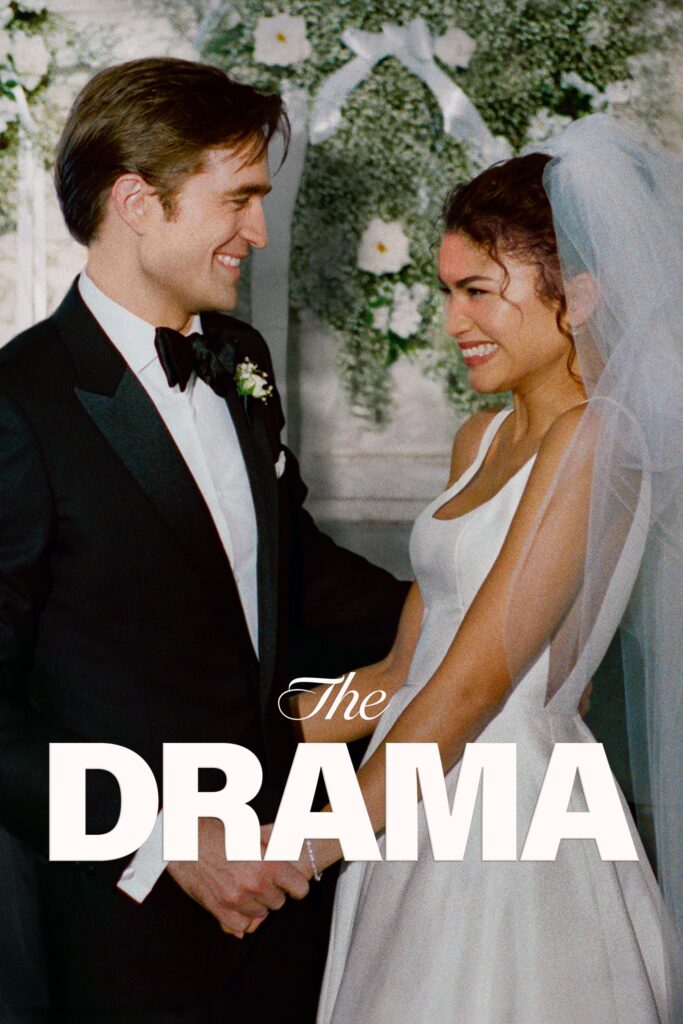
An engaged couple and their closest friends sit down for a pre-wedding dinner and start confessing the worst things they’ve ever done. What begins as awkward drunk admissions spirals into a revelation so extreme it blows up the relationship, the wedding, and everyone’s carefully held moral high ground. Borgli doesn’t try to fix it. He just watches the damage spread.
 

The slow build that pays off

The premise sounds like it could be a stage play, and in weaker hands it would feel like one. Four people around a table, drinking too much, playing a confession game that starts mild and ends catastrophic. The first couple of secrets are uncomfortable but manageable, the kind of thing you wince at and nervously laugh off. The screenplay lets you settle into that rhythm on purpose.

Then one confession lands so far outside the scale that it reframes everyone at the table. Not just the person who said it, but everyone else too, because their reactions suddenly become the real test. And the movie is sharp about this. It understands that how you react to someone else’s worst moment says more about you than whatever you confessed yourself. One character responds with such extreme, self-righteous fury that you instantly find yourself siding with the person who dropped the biggest bomb. Borgli knows exactly where your sympathy is going, and he’s playing your instincts against you the whole time.

The screenplay holds that tension for the rest of the runtime without ever giving you a release valve. There’s no wise friend who puts things in perspective. No heart-to-heart that clears the air. Just a slow, messy unraveling of a couple that looked perfect from the outside, and the growing realization that perfection was always performance. The writing trusts the discomfort enough to sit in it, and that restraint is what keeps you engaged for two hours of people mostly just talking.

Zendaya Is the real deal

This is the performance that puts Zendaya in a different category for me. She’s given a role that’s basically a contradiction: be the most sympathetic person in the room and the most unsettling one at the same time, and do it without a big explanatory monologue. She doesn’t get the tearful scene where she walks you through her feelings. She doesn’t beg for understanding. She doesn’t perform regret in any way the audience is trained to accept as redemption.

What she does is sit in the ambiguity and let the character’s past exist as a fact. She doesn’t try to make it easy to swallow. She doesn’t pretend it’s simple. And that restraint is what makes the whole movie work, because the second she reaches for a safety net, the entire moral tension collapses. A lesser performance would have caved. Zendaya holds the line.

Robert Pattinson is a harder sell. He throws himself fully into the groom’s psychological spiral, and the physicality of the breakdown is committed. But the character itself is the problem. The screenplay never shows you who this guy is before the crisis. You don’t get a stable, warm version of Charlie to compare the wreckage to. So when he falls apart, you feel the anxiety, but you don’t feel the loss. You’re watching a man crack without ever knowing what he looked like whole. It’s a bit disappointing that he doesn’t really give you much depth beyond the breakdown, especially when you know how much range Pattinson actually has.

The supporting cast does its job, though one character in particular is written so relentlessly mean that she occasionally pushes past believable. It doesn’t break the movie. But this isn’t Oppenheimer, and the film mostly gets away with running characters a bit hot because it’s not really going for that level of realism anyway.
The camera sells what the script can't

Where the screenplay plays it safe, the visual direction picks up the slack. Borgli uses the camera to show you what the characters can’t say out loud. The film visualizes intrusive thoughts. It puts the groom’s mental breakdown on screen in a way that’s honestly pretty creative, distorting focus, cutting to images that only exist in his head, making familiar rooms feel wrong. You don’t just hear that someone is spiraling. You see it in how the frame behaves.

This is what keeps The Drama from feeling like a filmed play, which is the death most dialogue-heavy dramas die. The visual storytelling adds a whole layer of psychological weight that conversation alone couldn’t hold. It’s not flashy. It’s not trying to be. But it’s the reason the second half keeps you locked in when the plot is basically people arguing in rooms.

The music stays deliberately in the background, and that’s the right call. A pushy score would’ve cheapened a movie that earns its tension through the performances and the camerawork. The sound mixing is clean but nothing to write home about. Nothing here is fighting for attention, and that’s actually a good thing. The movie knows its tension comes from people and silence, not from the soundtrack telling you how to feel.

A good time, not a deep one

The pacing is tight. The Drama never drags. Not once. For a movie that’s built almost entirely on people talking and reacting, that’s a real achievement. You are always curious about what happens next, always turning over whose side you’re on, always re-evaluating whether the person you were rooting for five minutes ago still deserves it. The drama does the work that action would do in a different kind of movie, and it pulls it off without ever raising its voice.

Where it stops short is in having something big to say. The movie is sharp about hypocrisy, about how easily people forgive themselves for things they’d crucify someone else for. It makes you uncomfortable in ways that stick around after the credits. But it doesn’t try to make a statement about relationships or honesty or forgiveness. It’s more interested in the mess than the meaning, more fascinated by how things fall apart than by what you should take away from it.

And honestly, I think that’s fine. Not every movie needs to be a profound experience. But a film this smart about how people really behave was in a position to go further, and the fact that it didn’t is the gap between 76 and something higher. The craft is there. The performances are there. The visual ambition is there. It just chose to be an expertly made ride instead of something that stays with you for weeks.

FINAL SCORE

76/100

VERDICT

The Drama is a well crafted, visually creative, and consistently engaging film that knows exactly how to keep you watching. Zendaya gives a performance that moves her into a whole new bracket. Borgli’s direction turns what could’ve been a stale dialogue movie into something you actually feel in your body. The central premise has real bite, and the escalation from awkward confessions to full relationship meltdown is handled with the kind of care that proves someone behind the camera understood exactly what makes a room feel dangerous.

Copyright © 2026 GlennAbraas.
All rights reserved.