MOVIE REVIEWS

The Drama

SPOILER REVIEW

Kristoffer Borgli

15-4-2026

''TLDR: The Drama takes a would-be school shooter, sits her across from a table of smaller hypocrites, and somehow makes her the person you're rooting for. Kristoffer Borgli follows the fallout with visual direction that makes you feel the anxiety in your own chest.

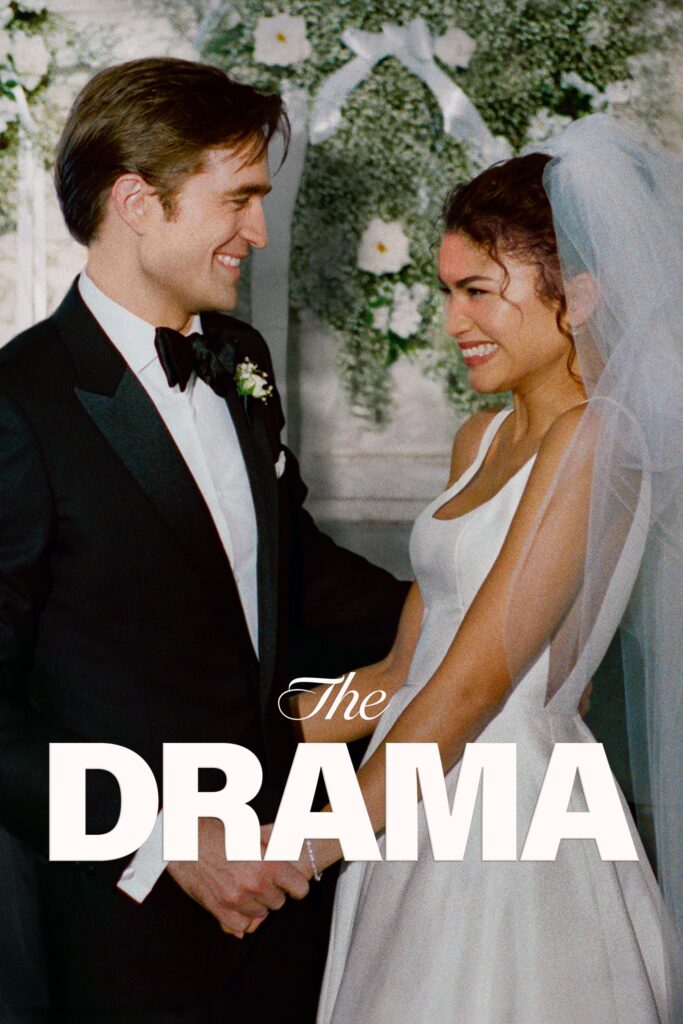
An engaged couple’s rehearsal dinner turns into a confessional that ends with a revelation about a planned school shooting, a wedding in freefall, and a quiet argument that total honesty might be the most destructive thing you can do to a relationship. Borgli shoots it like the anxiety is contagious, putting intrusive thoughts on screen and making a groom’s breakdown something you experience instead of just watch. The result is an anti-rom-com that cares more about how love survives ugliness than whether it should.
 

The confessions that set everything on fire

The whole movie starts on one dinner scene and the order things come out. The screenplay understands that sequencing is everything, and it builds the escalation with real care.

Mike admits he used an ex-girlfriend as a human shield during a dog attack. Uncomfortable, cowardly, but the table absorbs it and moves on. Charlie confesses to cyberbullying a kid so relentlessly in high school that the family had to move towns. Heavier, but the group processes it with some visible discomfort. Then Rachel drops that she locked a mentally disabled child in an abandoned trailer closet and left him there.

The room hasn’t recovered from that when Emma’s turn comes. Zendaya plays the buildup with visible, drunk anxiety, the kind of fidgeting that makes you brace for impact. And what she says rips the floor out: as a deeply isolated, lonely 15 year old, she planned a school shooting. She went into the woods and practiced with her father’s rifle. She practiced so much without ear protection that she blew out her eardrum. That quirky “deaf in one ear” thing that Charlie found charming on their first date? That’s not a random accident. That’s evidence of her preparing for a massacre.

The reason she stopped is almost more disturbing. On the exact day she brought the gun to school, another mass shooting happened at a local mall. She backed out because she didn’t want to be upstaged. Not because of empathy. Not because of fear. Because someone else beat her to it. The tragedy ironically swept her into a gun-control advocacy group that gave her the friends and community she’d been missing, and that belonging basically cured the isolation that was driving her in the first place. In her mind, she never pulled the trigger, so she didn’t do anything wrong.

Here’s where the screenplay gets really smart. This should make Emma the villain. Instead, the movie instantly makes her the most sympathetic person in the room, and it does it through Rachel’s reaction. Rachel, the woman who locked a disabled child in a closet, erupts with self-righteous fury so extreme that your sympathy swings immediately. You’re suddenly rooting for the person with the darkest secret because the person screaming loudest about it did something genuinely horrible herself and can’t see the irony. The movie gets something uncomfortable about how people work: the worst person in the room isn’t always the one with the worst secret. Sometimes it’s the one who’s loudest about everyone else’s.
Charlie breaks down before you ever knew who he was

The middle act belongs to Pattinson’s Charlie, and it’s where the movie both impresses and frustrates. Charlie can no longer look at Emma without seeing her as that 15-year-old with a gun. The film puts his intrusive thoughts directly on screen, flashing violent images over normal domestic moments, warping focus, making familiar spaces feel off. You stop watching a character have a breakdown and start feeling like you’re inside one yourself.

Charlie spirals publicly and badly. He tries to cheat on Emma with his assistant and fails. He gets into fights that leave him bruised. He drinks, he lashes out, and he refuses to actually talk to Emma about any of it, dumping his anxiety onto friends instead. And the movie is sharp about his hypocrisy. This is a guy who admitted to cyberbullying so severe it uprooted a family, but he can’t extend an inch of empathy to a teenager who never actually hurt anyone. He forgave himself for cruelty he committed. He can’t forgive Emma for cruelty she only thought about.

That observation is razor sharp. But the character underneath it? Less so. Pattinson throws himself into the spiral and the physicality is committed. The problem is the screenplay never builds a version of Charlie before the crisis. You don’t get to see the relationship working. You don’t feel the warmth before the cold sets in. So when he falls apart, you believe it, but you don’t feel what’s being lost. You’re watching a stranger crack. The movie needed a quieter first act for him, some breathing room to show you what’s worth saving before it starts tearing it down. Without that, his arc is convincing without being **heartbreaking**, and this is a movie that had the room to make it heartbreaking.

Zendaya holds the line

Zendaya is really proving herself here. Emma is an almost impossible role. She’s carrying the worst secret at the table, the kind that should make her impossible to root for, and she has to make you understand her without ever making you fully comfortable. She doesn’t get a big apology speech. She doesn’t cry for forgiveness. Emma genuinely doesn’t think she did anything wrong, and Zendaya has to let that sit without trying to smooth it over.

The restraint is what makes it work. When the table turns on her, she doesn’t beg. When Charlie spirals away from her, she doesn’t chase him with tearful explanations. There’s a scene earlier where she tries a stranger at a bar roleplay to snap Charlie out of his head, something playful and slightly desperate at the same time, and Zendaya walks that line between confident and vulnerable without overplaying either side. She’s arrived at the kind of role where there’s no safety net, and she works the entire runtime without one.

Rachel is played by Alana Haim, and she’s written as the moral counterweight, the person who reacts the hardest. But she’s pushed so far into being mean that she occasionally stops feeling real. The character works for what the movie needs, someone to expose the hypocrisy by embodying the most extreme version of it, but she’s mean to the point where it’s hard to believe she was ever part of this friend group. It doesn’t break the movie. This isn’t aiming for hard realism. But a version of Rachel with one more layer would’ve made the whole thing hit harder.

The camera does what the dialogue can't

Borgli’s direction is why this works as a movie and not just a filmed argument. A film that takes place almost entirely in conversational settings, dinner tables, living rooms, a diner booth, has no business being this visually engaging for two hours. The fact that it holds you without a single action sequence says everything about how much work the camerawork is doing.

The visual direction tracks Charlie’s mental state in real time. Early scenes are stable and warm. As he loses his grip, the frame starts messing with you. Focus shifts that shouldn’t be there. Quick cuts to images that only exist in Charlie’s head. It’s not effects-heavy or showy. It’s precise, and it’s what keeps the second half engaging when the plot is basically people fighting in rooms.

The music hangs back deliberately, and that’s the right call. A manipulative score would’ve cheapened a movie that builds its tension through performances and framing. The sound mixing is solid but nothing special, nothing to write home about. The movie knows its real soundtrack is the silence between characters who can’t talk to each other anymore, and it lets that silence do its work.

The pacing is tight from start to finish. The Drama never drags. For a movie built on conversation and reaction, you’re always hooked on what comes next, always rethinking whose side you’re on, always a little bit ahead or behind where the film wants you. The drama does the heavy lifting that action sequences would do in a different genre, and it does it without ever needing to raise its voice.

The ending that rewrites the whole movie

The climax gives you a brutally awkward wedding reception where every toast feels like it’s about to go wrong and every look between characters is loaded. When everything finally falls apart, a beaten up, emotionally wrecked Charlie retreats to a diner that Emma had mentioned visiting earlier. Small detail, planted early, pays off perfectly.

Emma eventually walks in and sits across from him. Earlier in the film, she’d tried to start a stranger at a bar roleplay to pull Charlie out of his spiral and reconnect. He was too disgusted by what she’d told him to play along. This time, she introduces herself as if they’ve never met. No apology. No explanation. No demand for one. Just a clean slate offered across a diner table.

Charlie, who at this point has destroyed whatever moral high ground he had, who tried to cheat, who got into fights, who never once managed to actually talk to Emma about how he felt, finally plays along. He introduces himself back. The movie ends.

The whole film’s argument clicks into place with that one gesture. The Drama doesn’t believe in radical honesty. It argues the opposite: some secrets are better off buried, and the performance of a relationship, choosing to see the person you love as the version you fell in love with rather than every dark thing they’ve ever been, is what keeps romance alive. Weddings are performances. First dates are performances. That roleplay at the end is a performance. And the movie’s position is that these aren’t lies. They’re the deal we all make with the people we choose.

I thought the twist with her being deaf because of practicing with the gun was pretty cool. It takes something the movie set up as a cute character detail and turns it into something genuinely dark, which is basically what the whole film does with the idea of a “picture perfect” couple. Whether you find the ending cynical or romantic probably says more about you than about the movie.

FINAL SCORE

76/100

VERDICT

The Drama is well crafted, visually creative, and consistently engaging. Zendaya gives a performance that moves her into a completely different bracket. Borgli’s direction turns what could’ve been a stale talky drama into something that gets under your skin. The confession sequence is one of the most effective pieces of escalation I’ve seen this year, and the ending lands with a quiet precision that sticks with you longer than you’d expect from a movie that’s content to not be about anything huge.

Where it falls short is in its own ambition. The movie is smart about hypocrisy. It’s sharp about how relationships survive on what we choose not to see. But a film this smart about how people actually work had the tools to go further, and the fact that it chose to stay an expertly crafted experience instead of a truly profound one is the gap between 76 and something higher. It didn’t really have anything earth-shattering to say, but hey, not every movie needs to be this profound thing.

Copyright © 2026 GlennAbraas.
All rights reserved.